
FEATURED HEADLINE
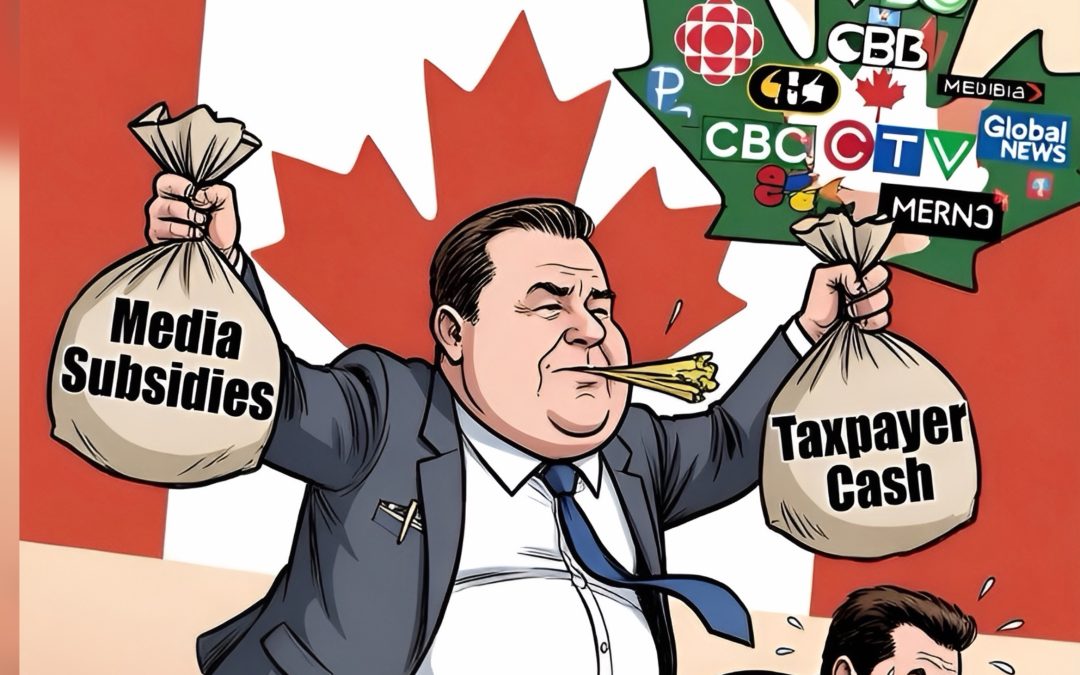
Yet again, Canada's legacy media has received yet another massive taxpayer funded handout, this time clocking in at 170 million dollars in 2025 alone just for private sector newsrooms. This figure comes directly from the Department of Finance Canada's own Report on Federal Tax Expenditures 2026. Seven long years have passed since the 2019 budget rolled out what politicians and industry lobbyists breathlessly called a temporary bailout package: 595 million dollars over five years to act as a short term lifeline for journalism supposedly crushed by digital disruption, plummeting ad revenue, and the rise of free online content. Instead of fading away as promised, these subsidies have ballooned into a permanent fixture of federal spending, extended again and again with no credible exit strategy in sight. What began as emergency aid for a struggling industry has quietly transformed into one of the most shameless examples of ongoing corporate welfare in modern Canadian history, with costs exploding far beyond any original projections and zero hard proof that a single dollar has produced stronger, more independent, or more valuable journalism for the average Canadian.
Break down the 170 million dollars for 2025 and the embarrassment only deepens. Roughly 75 million dollars flows through the Canadian Journalism Labour Tax Credit, a refundable payroll rebate that covers up to 35 percent of eligible salaries, capped at 29750 dollars per employee after the generous 2023 bump from the previous 25 percent rate on 55000 dollars. This is essentially the government writing cheques to cover journalists' paychecks, even for outlets that owe no taxes at all. About 86.5 million dollars pours into the Canada Periodical Fund, propping up magazines, community papers, and digital periodicals, complete with endless add ons such as the Special Measures for Journalism component that tacked on 12 million dollars specifically for 2025 to 2026 and another 38.4 million dollars stretched over three years beginning 2026 to 2027, courtesy of Budget 2025. Then there is the Local Journalism Initiative at around 19.6 million dollars, supposedly funding reporters in news deserts but really just another channel to funnel public money into selected outlets. These numbers are pulled straight from official government projections and Public Accounts records, yet they conveniently leave out the CBC's staggering 1.4 billion dollar handout for 2025 to 2026. Add it all up and federal media related spending sails past 1.7 billion dollars every single year, all while the national deficit sat at 26.1 billion dollars just from April to December 2025. That is real money forcibly taken from working Canadians to subsidize an industry that keeps telling them how essential it is, even as trust in that industry collapses.
The sheer waste is impossible to ignore when you look at the complete absence of meaningful results after all these years. Comprehensive, truly independent impact evaluations are not even required until 2027, so Canadians have been blindly pouring hundreds of millions into these programs for nearly a decade with no obligation for anyone to prove that the cash has led to more civic minded reporting, better local coverage, or any genuine revival of the sector. Claim volumes for the labour tax credit have doubled since the pandemic, which sounds impressive until you realize there is still no transparent, detailed public breakdown showing exactly which outlets pocket how much or whether those subsidized jobs are truly new contributions to journalism or simply replacements for positions that would have vanished without the government cheque. Polling after polling drives the embarrassment home: 76 percent of Canadians in 2024 told pollsters that these subsidies undermine objective reporting on the very government handing out the money, 73 percent in 2023 said the payments make it harder for journalists to hold authority accountable, and three quarters of respondents viewed the entire scheme as actively damaging journalistic objectivity. Total related subsidies ballooned to 325 million dollars across programs in 2024 to 2025, shattering the transitional aid narrative sold in Budget 2019 and exposing the whole thing as a slow motion fiscal train wreck.
The system is rigged to funnel the bulk of the cash to more than 500 Qualified Canadian Journalism Organizations, rubber stamped by the Independent Advisory Board on Eligibility for Journalism Tax Measures. That board, chaired by Colette Brin with Vice Chair Margo Goodhand and members including Bob Cox, Linda Hughes, Brenda O'Farrell, Michael Cooke, and Ravindra Mohabeer as of 2026, has approved hundreds of entities while smaller, truly independent operations frequently struggle to meet the criteria or get pushed aside entirely. Transparency is abysmal: no full public disclosure of exact amounts per outlet, no clear explanations for rejections, and no robust accounting for potential conflicts of interest among board members. Pile on the extra 100 million dollars flowing in every year from Google under the Online News Act and the picture turns even uglier: a toxic mix of direct taxpayer dollars plus coerced platform payments that critics say has turned large swaths of the Canadian press into little more than government influenced mouthpieces instead of a free, competitive, and trustworthy fourth estate.
This entire fiasco is not about protecting democracy or saving journalism. It is about propping up an industry that has squandered public trust largely because of these very entanglements. Extensions arrive like clockwork, each one contradicting the previous promise of temporariness, while costs are quietly projected to settle at 150 to 200 million dollars annually after 2027, still excluding the CBC's enormous slice of the pie. The cycle is depressingly predictable: politicians announce fresh funding rounds, industry groups cheer, the money flows, extensions follow, repeat indefinitely. Canadians keep footing the bill, the numbers keep creeping higher, and the evidence that any of this produces better, braver, more independent journalism remains thinner than ever. What was once pitched as a noble rescue mission for a vital public service has devolved into one of the most embarrassing, wasteful, and hypocritical ongoing subsidies in Canadian history, benefiting a handful of entrenched media interests while steadily eroding whatever faith remains in both the press and the politicians who keep signing the cheques.
LIKE OUR WORK?
Recent Comments